Even a cursory review of the Federalist Papers will reveal this wasn’t the Founders’ understanding of democracy.
Whenever I've heard people say that something about a book is revealed by "even a cursory review" the implication is that an in-depth review would come away with the same impression about what the book has to say. I guess it is usually the case (at least when it comes to the most important theme or thesis) that an initial impression is correct. But when someone says "even a cursory review reveals" this or that, isn't that person implying that his experience is that initial impressions (the "cursory review") are actually wrong much of the time, at least kinda often? Otherwise why do they say even?
And then again, maybe saying "even a cursory review reveals..." is an admission by the speaker that he didn't read the whole book, and that he's leaving himself an out just in case the cursory review isn't consistent with what an in-depth review would conclude?
יום שני, 15 בספטמבר 2008


יום שישי, 12 בספטמבר 2008
Global warming
From Richard A. Muller's Ice Ages and Astronomical Causes
Beginning in the early 1900s, the climate of the world began to warm. This is evident in Figure 1-1, which shows the average Earth surface temperature from 1880 through 1999. The temperature is an area-weighted average over the land and ocean compiled by the National Oceanographic and Atmospheric Administration, using an averaging technique devised by Quayle et al. ; see also . In the plot, "zero" temperature is defined as the temperature in 1950. The fine line shows the monthly temperatures; the thicker line shows the 12 month yearly averages.
Beginning in the early 1900s, the climate of the world began to warm. This is evident in Figure 1-1, which shows the average Earth surface temperature from 1880 through 1999. The temperature is an area-weighted average over the land and ocean compiled by the National Oceanographic and Atmospheric Administration, using an averaging technique devised by Quayle et al. ; see also . In the plot, "zero" temperature is defined as the temperature in 1950. The fine line shows the monthly temperatures; the thicker line shows the 12 month yearly averages.
The figure shows that the 20th century had a temperature rise of nearly one degree Celsius. That may not sound like a lot, but its effects are quite noticeable. In Europe, the great glaciers of the Alps, such as the Mer de Glace near Chamonix, have been in retreat, and the canals of Holland almost never freeze over, as they did in an earlier era to allow Hans Brinker to silver skate into legend. The effects elsewhere on the globe are more severe, with large areas of Central Africa, once fertile, becoming arid and no longer capable of supporting a large population. Although the reason for this warming is not fully understood, many climate scientists think it is the result of the addition of carbon dioxide and other greenhouse gases into the atmosphere by humans.
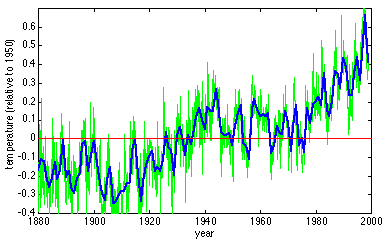
Figure 1-1 Global warming
As we go back in time in search of earlier records, the historical record becomes less reliable. Fortunately, Nature has provided its own recording mechanism. As we will explain in Chapter 4, measurements of oxygen isotopes yield an estimate of ancient temperatures combined with total global ice volume – a combination which is just as interesting as temperature alone, if not more so. Data from a kilometer long core taken from the Greenland glacier, as part of the Greenland Ice Sheet Project "GISP2" , are shown in Figure 1-2. For comparison purposes, the zero of temperature scale for this plot was set to match that of the previous plot. For historical interest, we marked some events from European history.
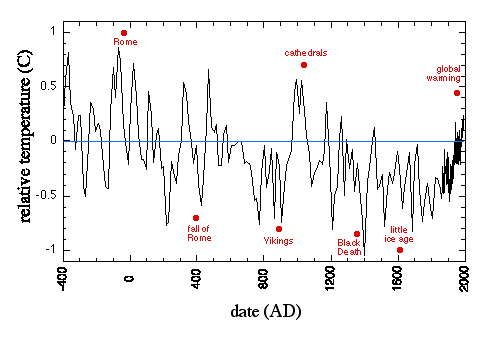
Figure 1-2 Climate of the last 2400 years
Political stock market

There's been quite a turnaround over at intrade.com, in the last week or so. An interesting question: what part of these prices is a risk premium, and what is the sign of that premium? At least the sign part is straightforward: if the "marginal investor" is a Republican, then the price of McCain is lower, and the price of Obama higher, than their respective probabilities of winning the race.
The price of "Sarah Palin to be withdrawn as Republican VP nominee", which stood at 18 on September 3, is now down to 6.
Solidarity goods
In his Public Intellectuals, Richard Posner characterizes a certain kind of op-ed column as a "solidarity good"; you read it to feel better about beliefs you already hold. As solidarity goods go, Roger Cohen's piece in yesterday's New York Times is a perfect example.
And he took his nation into desert wars and mountain wars, but, lo, he thought not to impose taxation, not one heifer nor sheep nor ox did Bush demand of the rich. And it came to pass that the nation fell into debt as boundless as the wickedness of Sodom. For everyone, Lehman not least, was maxed out.
I like that term, "solidarity good". But what should we call an op-ed that's sure to meet with near-unanimous disapproval? This Obama plug in the Jerusalem Post, for instance.
And he took his nation into desert wars and mountain wars, but, lo, he thought not to impose taxation, not one heifer nor sheep nor ox did Bush demand of the rich. And it came to pass that the nation fell into debt as boundless as the wickedness of Sodom. For everyone, Lehman not least, was maxed out.
So heavy was the burden of war, and of bailing out Fannie and Freddie, and of financing debt with China, that not one silver shekel remained to build bridges, nor airports, nor high-speed trains, nor even to take care of wounded vets; and the warriors returning unto their homes from distant combat thought a blight had fallen on the land.
So it was in the seventh year after the fall of the towers. And still Bush did raise his hands to the Lord and proclaim: “I will be proved right in the end!”
Almost all of the 379 readers' comments gush appreciation for the solidarity good they've so thoroughly enjoyed, and these comments in turn serve as second-order solidarity goods to be appreciated by readers who clicked the "Recommended" button. (You'd think "recommended" would be for a reader comment that says something notable, but no; here's one that got 118 "recommended" votes: Truly stunning. And I am normally a person of many words. But this piece has left me speechless. - ej, Ft. Collins, CO.)I like that term, "solidarity good". But what should we call an op-ed that's sure to meet with near-unanimous disapproval? This Obama plug in the Jerusalem Post, for instance.
יום שלישי, 9 בספטמבר 2008


יום שני, 8 בספטמבר 2008
How to buy respectability
What's the chance of the New York Review of Books publishing a "thought piece" by a currency speculator who's gotten lucky a few times but otherwise would elicit yawns and rolled eyeballs from the kind of academic
luminaries the NYRB normally turns to?
Pretty good, apparently, if he's already spent a fortune to fight evil (as the NYRB sees it).
Here's Paul Krugman ripping Soros back when Soros was just another pretentious rich guy:
luminaries the NYRB normally turns to?
Pretty good, apparently, if he's already spent a fortune to fight evil (as the NYRB sees it).
Here's Paul Krugman ripping Soros back when Soros was just another pretentious rich guy:
Someone should tell him it doesn't help his case to dress up fairly simple ideas in pretentious philosophical language. In particular, many people have argued that financial markets tend toward boom-and-bust cycles, that investors tend to engage in herd behavior, and that financial systems are subject to self-justifying panics. But such observations are not enough for Soros: For him they must serve as illustrations of the general principle of "reflexivity," which I take to mean that human perceptions both affect events and are themselves affected by them. Gosh, I never thought of that!
הירשם ל-
רשומות (Atom)